Syniverse API platform

API website and developer portal design

I design end-to-end product experiences and the UX systems that sustain them — from early foundations through growth, optimization, and scalability.
Initial company & product state

Company state

Syniverse is a global telecommunications company offering APIs for messaging, identity, and network services. I worked as part of a three-person agency team engaged to design a new API website and developer portal.

Product state

From the perspective of developers evaluating Syniverse’s APIs:

  • There was no unified API website or developer portal
  • API documentation was fragmented and difficult to navigate
  • Developers could not test APIs in the browser
  • Pricing and usage were unclear
  • No clear path existed to understand what APIs were available or how to get started

Developers relied on external tools and scattered resources, which slowed onboarding and limited adoption.

Challenge

Create a clear, usable API experience that allowed developers to:

  • Understand what APIs were available and what they did
  • Explore pricing and usage without guesswork
  • Test APIs directly in the browser
  • Move from discovery to implementation without switching tools

The engagement required defining the API experience end to end — across marketing, documentation, pricing, identity, and testing — within a single, coherent interface.

I worked as part of a three-person agency team to design a new API website and developer portal, defining the developer experience end-to-end: marketing, discovery, documentation, identity, pricing, and in-browser testing.

Developer portal and API testing

  • Mapped core developer workflows: discovery, sign up, authentication, testing, billing, and support
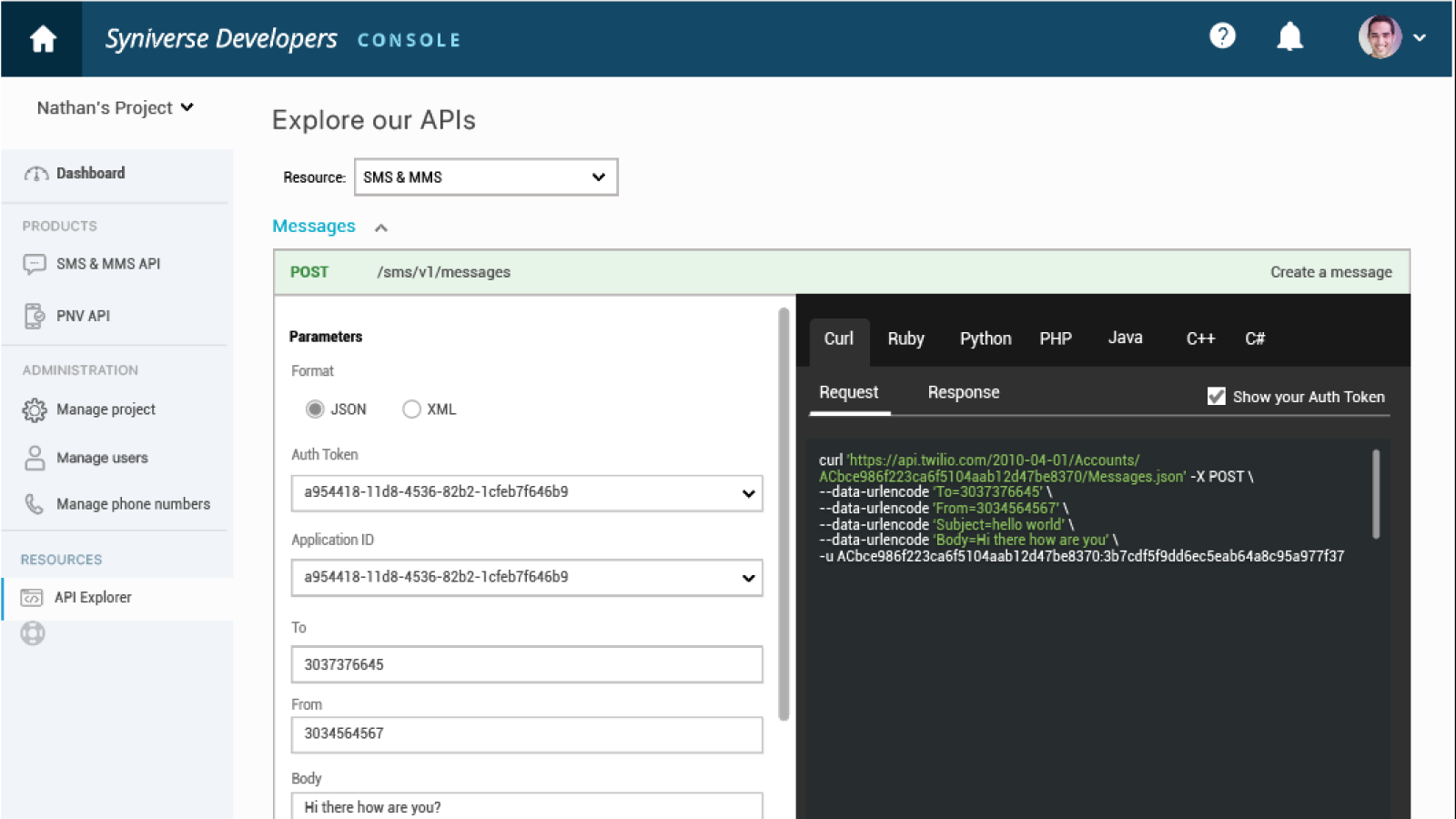
  • Designed a browser-based API testing console supporting:
    • HTTP method selection
    • Authentication handling
    • Multi-language code samples
    • Real-time request and response feedback
    • One-click code copy
  • Created identity and permission models to clarify how users, apps, projects, and APIs relate

This unified API discovery and hands-on testing into a single experience for the first time.

Website and information architecture

  • Defined the structure and navigation for the API website
  • Organized APIs, pricing, documentation, resources, and content into clear categories
  • Simplified layouts and reduced dense, jargon-heavy content
  • Designed interactive elements such as API previews and a pricing calculator

New API documentation website design

Users could easily understand what Syniverse offered, preview APIs, and navigate the product hierarchy without friction. Pricing became straightforward — a major pain point for telecom APIs — reducing confusion and supporting transparency.

API documentation pricing page

Telecom pricing is notoriously confusing. I designed:

  • Dedicated pricing page
  • Transparent API pricing breakdowns
  • Bundling strategy recommendations
  • A calculator to estimate expected costs

API docs portal

Old design

The existing design did not provide any way to test the API, and was very text-heavy. Although there is a right sidebar, these aren't other API categories, so it creates a "mystery meat" experience as to what to expect in each of the categories. Perhaps these are different sections in the page? There is no way to move quickly between API categories.

My team didn't actually know about this until towards the end of the project, as the agency was not working with this part of the company.

API portal

The API portal brings forward available API categories, and enables developers to quickly test methods using their preferred language.

Developers can easily see which languages are supported, and test requests and responses using their authentication credentials.

API methods

This shows the various API methods, making it clear what method is a GET, POST, and DELETE.

Mapping out permissions

None of this information had been figured out, including all of the relationships between entities, so a large part of this project was figuring out  how everything would work together. To do so, I created:  

  • Comprehensive identity + permissions models
  • Data relationship diagrams
  • Scenarios covering: orgs with sub-orgs, users in multiple teams. apps in projects, APIs assigned to apps, permission inheritance logic

This work ensured:

  • Security alignment
  • Scalable architecture
  • Predictable developer experience

Here are flow excerpts:

Identity model diagram: Charting out how the new system would work for various scenarios, including organizational units within a company, adding applications and users to projects, and adding APIs to applications.

Permissions mapping: There were many scenarios to map out, including projects that were within organizational units, not in them, or orgs within orgs.

Impact

The new API website and developer portal made Syniverse’s offerings understandable and explorable without prior telecom expertise.

  • On the website: users could finally understand the offering, preview APIs, and navigate the product hierarchy without friction. Pricing became straightforward — a major pain point for telecom APIs — reducing confusion and supporting transparency.
  • On the developer side: the console reduced onboarding time and eliminated the need for developers to switch tools just to test endpoints. This cut down on support requests, improved self-service, and supported adoption efforts.

Because I left the agency shortly after delivery, I don’t know the final implementation results — but the redesigned system provided the first cohesive developer and API experience.